

What Recruiters Actually Look for in Early-Career Geoscience CVs
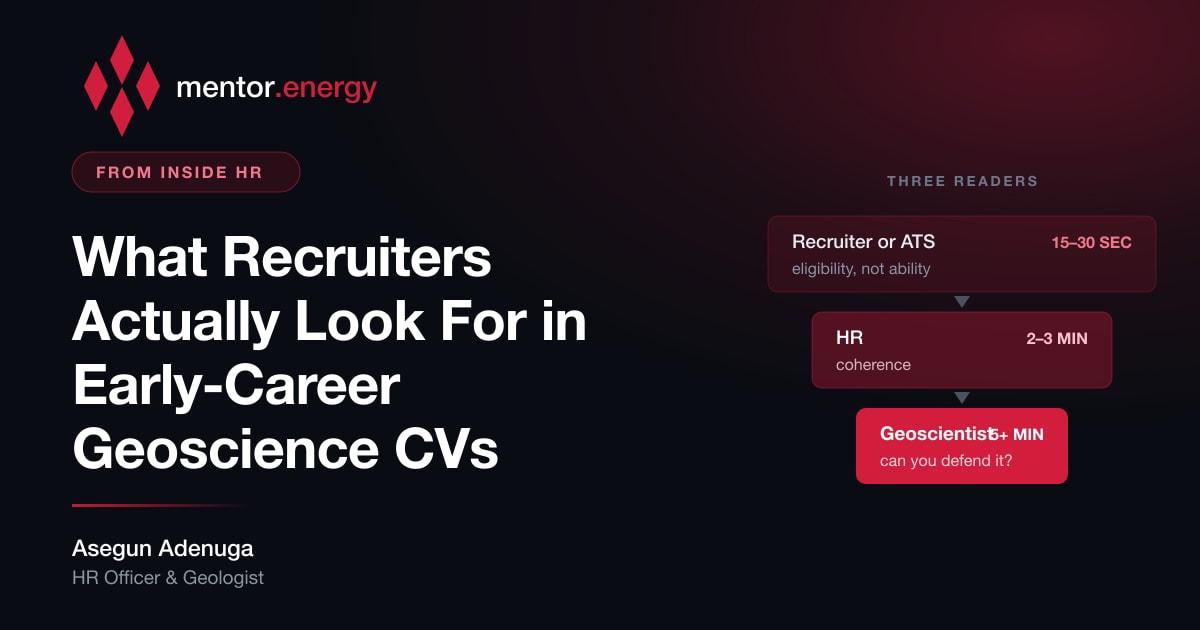
Graduates write CVs as if a geoscientist will read them carefully. In practice an application passes through three separate readers, and each one is looking for something different.
How the screening really happens
Filter one: the recruiter or the applicant tracking system — 15 to 30 seconds
This reader is usually not a geoscientist. They are checking eligibility, not ability: degree discipline, class of degree or CGPA, graduation year, location, and whether the named software matches the job advert. If a keyword is missing, the CV is out before anyone technical sees it.
In Nigeria the hard gate for most operator graduate schemes is either a First Class or a Second Class Upper within a relevant discipline, plus a graduation window.
It is also worth understanding who is actually doing this reading. In the oil and gas industry, many recruitment exercises are outsourced to recruitment and staffing companies — Workforce, Jobberman and others. These firms source candidates, review applications and screen CVs against the requirements of the role. Applicant Tracking Systems may also be used to organise and filter applications based on qualifications, skills, experience and keywords. Only after that initial screening are shortlisted CVs forwarded to the Human Resources team and the relevant hiring managers inside the company. It lets companies manage large volumes of applications efficiently, but it means the first judgement on your CV is often made outside the company you applied to.
Filter two: HR or talent acquisition — two to three minutes
Now the question is coherence. Does this person have a direction, or a collection of activities? Are the dates continuous and explainable? Is there evidence they can work in a team, write, and present?
Unexplained gaps and unexplained pivots get flagged here rather than rejected outright — but they become interview questions you will have to answer.
Filter three: the hiring geoscientist or team lead — five minutes or more
This is the only reader who cares about depth. They are asking one question: can this person defend the work on the page?
They will look at the undergraduate thesis or project, the data type, the software, the basin, and the interpretation. A software name with no project attached to it reads as a course certificate, not a capability.
The practical lesson is that a CV has to survive a non-technical reader and then satisfy a technical one. Most early-career CVs are built for only one of the two.
The eight things that carry the most weight
1. Class of degree and academic ranking. At entry level this is the strongest available proxy for ability, because there is little work history to judge. A stated CGPA and class rank does more than a general claim of academic strength.
2. Discipline alignment. Geology, Geophysics and Applied Geophysics are not interchangeable to a hiring manager. State clearly which lane you are in.
3. Software, tied to a project. Petrel, Techlog, Kingdom, ArcGIS, Hampson-Russell, RokDoc, PetroMod. Listing them gets you past the keyword filter. Showing where you used one, and on what dataset, gets you past the technical reader.
4. A defensible project. It should state the objective, the data, the method and the result. A thesis title on its own only hints at what was worked on.
5. Industry exposure. Internship, industrial attachment, or contract work with an operator, service company or consultancy. Even short placements matter, because they show you have seen how the work is actually organised.
6. Professional affiliation and conference activity. In the Nigerian market, NAPE, NMGS and SPE membership is close to expected. Presenting a paper or abstract at a NAPE, NMGS or SPE conference is a genuine differentiator at this stage, because very few graduates do it.
7. Evidence of communication and teamwork. Presentations, teaching, leadership roles, report writing. Technical teams reject candidates who cannot explain their work far more often than they reject candidates who are slightly less technical.
8. Presentation of the document itself. Typos, inconsistent spacing, embedded logos that break parsing, and a summary that contradicts the rest of the CV all signal carelessness. In a discipline built on attention to detail, that reads badly.
Where this leaves you
Write for all three readers. Get past the keyword filter with the right discipline, class and software named plainly. Give HR a coherent story with no unexplained gaps. Then give the geoscientist something they can interrogate — a project with an objective, a dataset, a method and a result.
Most graduates do one of those three well. Doing all three is not harder work; it is just knowing that three different people are reading.
Get hired faster — free career tips
Join the list for new lessons, downloadable templates and Nigerian energy-sector job tips. No spam, unsubscribe anytime.
Tags
Asegun Adenuga
Continuous Learner
Ready to accelerate your career?
Connect with industry mentors and take the next step in your energy career.
Get Started Free